
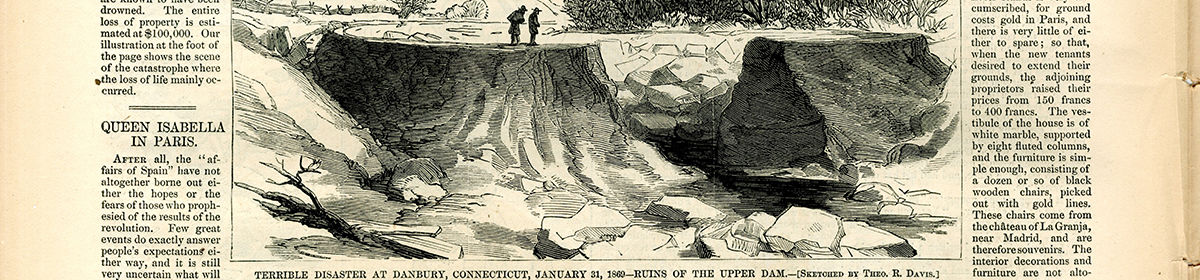
Belle da Costa Greene, the first director of the Morgan Library, was a trailblazing female Black special collections librarian whose power in the field, then male-dominated, was extraordinary, and in a world where the only way for that to be possible was by pretending to not be Black.
Category: Uncategorized
Diversity, little equity, but much-needed inclusion in the War for Independence
When the 13 English colonies in America fought and won their independence and formed the United States, Connecticut had at least 820 Black soldiers in its ranks – roughly 20% of the Black population of Connecticut (~4300).
Enslavement of Black persons was legal in Connecticut, yet the same percentage of Black persons filled the State’s ranks in the Revolution as White persons.
The National Battlefield trust wrote in 2021:
“The main military force, which coalesced under General George Washington as the Continental Army, was not an integrated army until 1776. In November of 1775, Washington barred the enlistment of free Blacks and slaves. Within two months, however, Washington reversed this decision, and despite many attempts to block Blacks from serving their country, hundreds of Blacks enlisted nonetheless. Many Blacks who fought and were enslaved fought for their freedom and independence as a person of color. After the war, many Blacks gave their pensions and enlistment bounties to their former masters as a payment for their freedom. Cuffee Wells is just one example. Wells was a surgeon in the Continental Army and after his service in the Revolution, he paid his enlistment bounty to his former master and lived the rest of his life as a free man in Lebanon, Connecticut.”
https://www.battlefields.org/learn/articles/george-washingtons-integrated-army
U.S. Government Data
Many of the Federal resources that were commonly available are no longer viewable online, and permanent URLs in library records may not resolve.
The Internet Archive has copies of many Government documents, sites, and data sets, but they do not have all the public data that had been previously freely available. Visit: https://web.archive.org/ (Internet Archive) if you are looking for a particular resource. The whitehouse.gov site as it appeared during the previous administration has been archived. You can find it here: https://bidenwhitehouse.archives.gov/
Doris Ann Rourke – WestConn’s first archivist
In 1977,  Doris Ann Rourke (nee Hagelin) published the first inventory of archival materials at WestConn – the first step in formalizing the archival operation in the library.
Doris was born in Touhy, Nebraska in 1917 and was a graduate of the University of Nebraska. During World War II, in 1943, she married Private Edward Rourke of Beacon Falls, CT. She worked as a teacher much of her career before coming to WestConn in 1970 as a librarian.
She received her Master’s degree in library science from Southern while at WestConn where she worked until 1982. Doris passed away in California in the same year that WestConn celebrated its centennial, 2003.
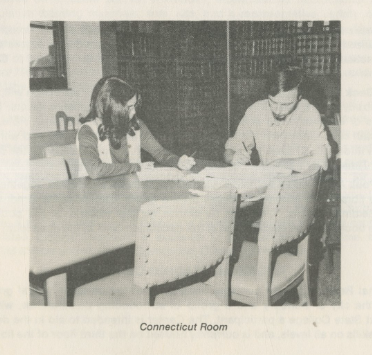
Prior to Doris Rourke, Marie A. Green, whose title was “Head of Technical Processing,” listed “Archivist” as a responsibility, but the facility at that time was less of a functioning archive and more of an area in the library. They called it the Connecticut Room in the “new” Haas Library in 1970 and was located on the third floor. There is still a Connecticut Room in the basement of the Haas Library.
WestConn’s first librarian, Ella Mead Brush
WestConn was founded in 1903 and its first graduating class was in 1906. From its founding, WestConn had a library and its first librarian was a graduate of Smith College in Amherst, MA, who held the position for more than eight years.
The original library in Old Main now is home to the Department of Admissions, but for sixty years it was the college’s only library.


- Birth: 20 Sep 1876, in either Greenwich or New Fairfield, Fairfield County, Connecticut, USA
- Her parents were Alexander B. Brush, a prosperous farmer, and Mary Louisa Mead, both of New Fairfield

- Death: 25 Oct 1931 (aged 55), Greenwich, Fairfield County, Connecticut, USA
- Graduated from Smith College class of 1904
- Librarian at WestConn until 1912.
- Went on to be a librarian in Greenwich, CT.
- Died of a cerebral embolism while living with her sister Emma in Asheville, NC
- She had 3 sisters
The Library’s homepage 20 years ago today…
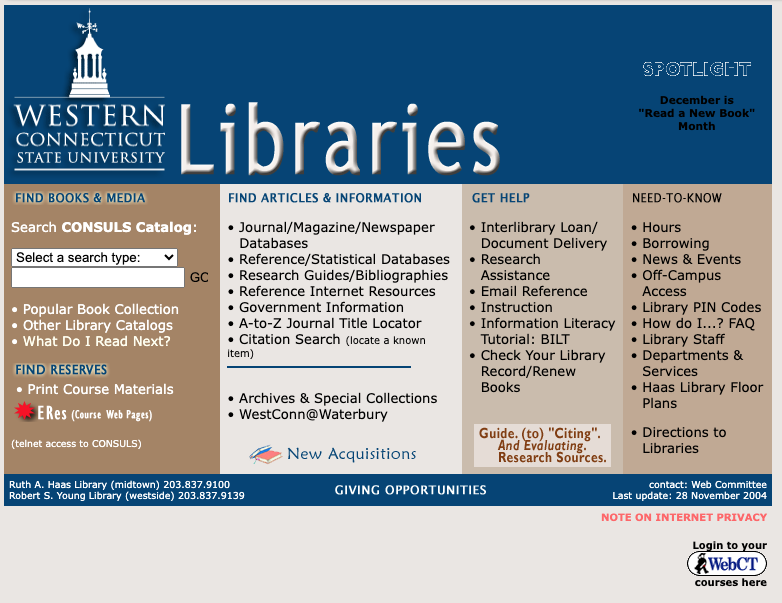
Find other residue of the old Web at https://web.archive.org/
Lincoln’s wartime day of thanksgiving
 In 1863, as the Civil War was about to enter its final full year, the Hartford Courant wrote on Thanksgiving day which in 1863 occurred today. It might give some insight on how the holiday was perceived at that time. See the WCSU Library’s databases to see more from the Hartford Courant. https://libguides.wcsu.edu/az/databases?a=h
November 7 – 250 years ago

The Connecticut Courant (precursor to the Hartford Courant) reported on the good work done by state delegates in Philadelphia, representing their constituents. For access to the historical issues of newspapers, see WCSU’s news databases: https://libguides.wcsu.edu/databases/db_news
The Voynich Manuscript – the ultimate cataloging challenge?
From Wikipedia- The Voynich manuscript is an illustrated codex, hand-written in an unknown script referred to as Voynichese.[18] The vellum on which it is written has been carbon-dated to the early 15th century (1404–1438). Stylistic analysis has indicated the manuscript may have been composed in Italy during the Italian Renaissance.[1][2] While the origins, authorship, and purpose of the manuscript are still debated, hypotheses range from a script for a natural language or constructed language, an unread code, cypher, or other form of cryptography, or perhaps a hoax, reference work (i.e. folkloric index or compendium), or work of fiction (e.g. science fantasy or mythopoeia, metafiction, speculative fiction) currently lacking the translation(s) and context needed to both properly entertain or eliminate any of these possibilities.
Lisa Fagin Davis has an interesting 62 tweet long analysis of the manuscript, viewable here: https://threadreaderapp.com/thread/1557092705485967360.html
There’s also an article in the most recent Atlantic.
Juneteenth in the White Connecticut Press… a story of racism and perseverance
The Juneteenth holiday does not come up in a search of the Library of Congress’ Chronicling America database, scoped to Connecticut newspapers before 1963.
However, historically it appears that communities in Connecticut did celebrate, but referred to the celebrations to mark the abolition of slavery resulting from the Union military victory in the Civil War as “Emancipation Day.” It appears that the “Emancipation Day” was sometimes observed in January, April, June or August.
Below are a sampling of the oldest Connecticut clippings found regarding the observance of the holiday. Please be advised that the language and attitude of the articles is frequently racist.
More importantly, however, these clippings document the persistence of the holiday, which remained part of the nation’s patriotic celebrations, despite being ignored or denigrated by the White press over the past 159 years.
The Hartford Courant, August 3, 1865 – an August celebration in Brooklyn, NY, 4 months after Lee’s surrender at Appomattox, VA.
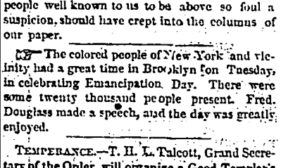
Litchfield Enquirer, January 4, 1872 – January celebration in New Haven
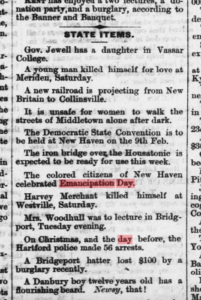
July 19th, 1872 – Willimantic Journal

August 8, 1873, the Connecticut Western News decided to be particularly racist in referring to the celebration.
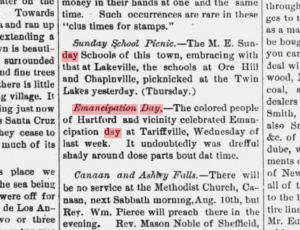
August 7, 1874, the Willimantic Journal reports on Frederick Douglass’ presence at the Bridgeport celebration.

August 8, 1880, Morning Journal Courier reported on the celebration at Elmira, NY.

Aug 2, 1881, Morning Journal Courier again…

April 28, 1882. The Willimantic Journal placed the celebration in Washington, D.C. in April, and with a racist flourish.

August 1, 1894, Stamford Daily Advocate – Frederick Douglass in attendance at Brooklyn celebration.
August 27, 1908, Stamford Daily Advocate – twenty days after the fact.
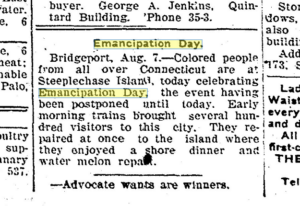
July 7, 1925, the New Britain Herald, 99 years ago, mentions “Emancipation Day” in Oklahoma as being celebrated on June 19th. In the story, a Black man was sentenced to die on the Juneteenth holiday, but the Sheriff who was to carry out the execution forgot, and arrangements had to be made to execute the prisoner at a later date.

Newspaper and archival collections provide a means to explore topics such as this.