More Moryl

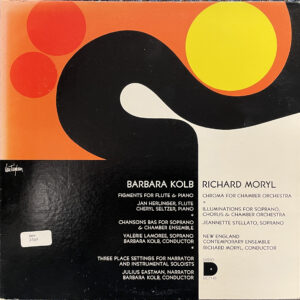
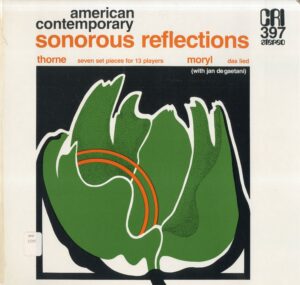
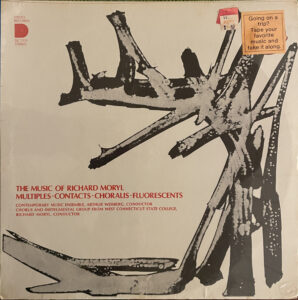
Cover of Moryl's albumReaders of this blog will notice recent mentions of composer Richard Moryl, who, as stated in an earlier post, lived in Danbury for a time in the 1970s. For three decades, Moryl served as a music and composition professor at WestConn in Danbury, CT, as well as the University of Connecticut and Smith College.

Essentially, the interest in Moryl began with a score for an experimental piece that was finally cataloged after it had been lying around untouched for many years (another story). Intrigued by the score, the archivist (me) began looking for music in WestConn’s collection by Moryl.  An interesting and exciting revelation that came out of that search was that Moryl worked with WestConn students in the 1970s for one of his recordings.  Unfortunately, that LP which was listed in the Library’s catalog was missing.  Fortunately, that same archivist was able to find for sale a sealed copy of the record online.  It was purchased and donated to the archives.

What we have is an interesting artifact that shows the intersection of this college with cutting edge composers.  It also bears a Peaches Records price tag ($.49) – truly an artifact from the 1970s.  Click the image for more information on the record.
Experimental music composer in Danbury in 1973

Richard Moryl composed: Madrigals (so, that I would like to die) : for chamber choir (playing perc. instrs.) and amplified piano in Danbury between 1973 and 1974.

Moryl (b. 1929, d. 2018) attended Columbia and Brandeis Universities and was the founder and director of the Charles Ives Center for American Music (CICAM).  Later he founded and directed the New England Contemporary Music Ensemble.

Here is a digitized version of his piece, Madrigals (so, that I would like to die) : for chamber choir (playing perc. instrs.) and amplified piano

Veterans’ Day

Just 4 days before the armistice on November 11, 1918 at 11AM, Mrs. Hawley, who had learned of the death of her son a couple of weeks prior, received a condolence letter from her sister. Because of the military operations involving U.S. troops in the fall of 1918, this letter was one of many similar pieces of correspondence that were sent to American families that November. After the Second World War, November 11th changed from Armistice Day to Veteran’s Day.

https://archives.library.wcsu.edu/omeka/items/show/2578
George B. Hawley Papers

Dam breaks – even in Danbury

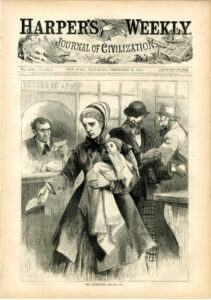
Cover of the 1869 Harpers WeeklyThe devastating tragedy in Libya resulting from failing dams reminds us of the number of dams in the Danbury area. In 1869, the Kohanza dam broke in Danbury, which resulted in water and ice crashing into downtown Danbury.  According to Harper’s, 13 were killed and it wrought $100,000 in damages (something like 2.2 million today). Take a look at the Harper’s Weekly that reported on the local event.


New “discovery” – an inscribed print from the 1930s

Among our WCSU Art Department print collection, there was an etching framed with an inscription to Ernest Roth. Great, right? Not really. We couldn’t read the signature on the piece. It was Donald M. K… something. Well, that’s how it’s been for the last decade. Using a bit of AI (Google image search), we were able to nail down that the etching might be of the Louvre in Paris. We confirmed it was. Great. But AI couldn’t match the piece of art to anything. Well, who the heck was Ernest Roth, then? I mean, we couldn’t find a Donald M. K… Ernest Roth turns out to be a highly regarded artist who specialized in etching. Well, that was something. We were trying to identify an etching and here was one inscribed to a great etcher. It had to be him (we hoped). The great etcher’s full name was Ernest David Roth. So, back to Google with the search: “Ernest David Roth” etching artist “Donald M.”

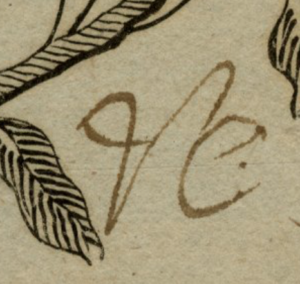
Guess what? A site came up that mentioned Ernest David Roth and a promising etching artist Donald Morris Kirkpatrick. A gallery selling his work had a piece with Kirkpatrick’s signature (which doesn’t look much like Kirkpatrick) – and they matched! Through a bit more digging, we could gather that the etching was probably created in the 1930s.

See https://lushergallery.com/kirkpatrick-donald-morris-biography for more info on Kirkpatrick and https://archives.library.wcsu.edu/omeka/items/show/1823 for a look at WCSU’s etching by the artist.

New “discovery” this week from 1717

We digitized a letter we had in the Truman Warner Papers listed as the “Granville Letter.” In looking into it, we see that it mentioned an enslaved person and describes life in 18th century rural New England. Definitely, we will be investigating this letter further. Read the whole story at:
https://archives.library.wcsu.edu/omeka/items/show/7957. Let us know what you think of our transcription.