As the semester comes to a close, we’re remembering September – not 2025 – September 1969, when there were IBM cards and beanies for first-years. 
Author: admin
The late Jane Goodall – part of WestConn’s community since 1995
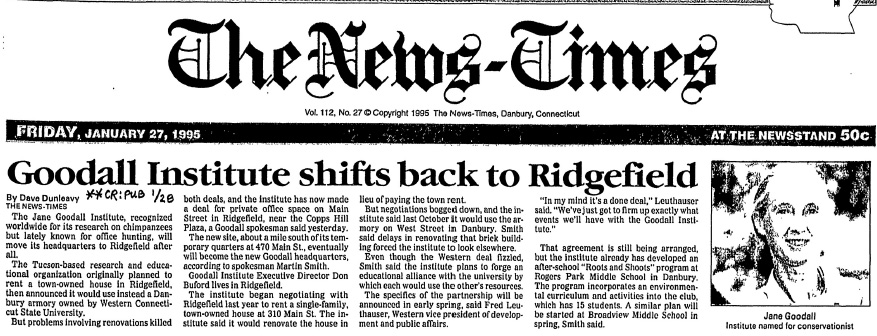
– An article regarding negotiations regarding the institute’s association with WestConn in 1995. This article and others on Jane Goodall are available from the Haas Library databases (Access World News).
Juneteenth in the White Connecticut Press… a story of racism and perseverance (re-post)
The Juneteenth holiday does not come up in a search of the Library of Congress’ Chronicling America database, scoped to Connecticut newspapers before 1963.
However, historically it appears that communities in Connecticut did celebrate, but referred to the celebrations to mark the abolition of slavery resulting from the Union military victory in the Civil War as “Emancipation Day.” It appears that the “Emancipation Day” was sometimes observed in January, April, June or August.
Below are a sampling of the oldest Connecticut clippings found regarding the observance of the holiday. Please be advised that the language and attitude of the articles is frequently racist.
More importantly, however, these clippings document the persistence of the holiday, which remained part of the nation’s patriotic celebrations, despite being ignored or denigrated by the White press over the past 160 years.
The Hartford Courant, August 3, 1865 – an August celebration in Brooklyn, NY, 4 months after Lee’s surrender at Appomattox, VA.
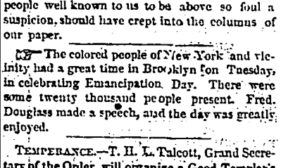
Litchfield Enquirer, January 4, 1872 – January celebration in New Haven
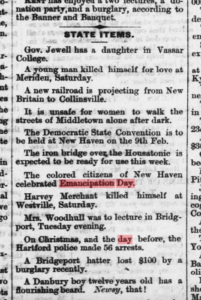
July 19th, 1872 – Willimantic Journal

August 8, 1873, the Connecticut Western News decided to be particularly racist in referring to the celebration.
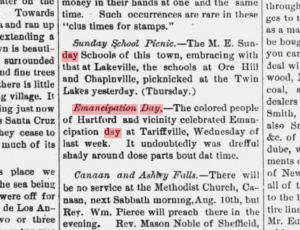
August 7, 1874, the Willimantic Journal reports on Frederick Douglass’ presence at the Bridgeport celebration.

August 8, 1880, Morning Journal Courier reported on the celebration at Elmira, NY.

Aug 2, 1881, Morning Journal Courier again…

April 28, 1882. The Willimantic Journal placed the celebration in Washington, D.C. in April, and with a racist flourish.

Stamford Daily Advocate, September 23, 1896

August 27, 1908, Stamford Daily Advocate – twenty days after the fact.
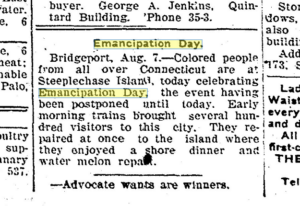
July 7, 1925, the New Britain Herald, 100 years ago, mentions “Emancipation Day” in Oklahoma as being celebrated on June 19th. In the story, a Black man was sentenced to die on the Juneteenth holiday, but the Sheriff who was to carry out the execution forgot, and arrangements had to be made to execute the prisoner at a later date.

Newspaper and archival collections provide a means to explore topics such as this.
Bonus Army arrives in Washington, May 29
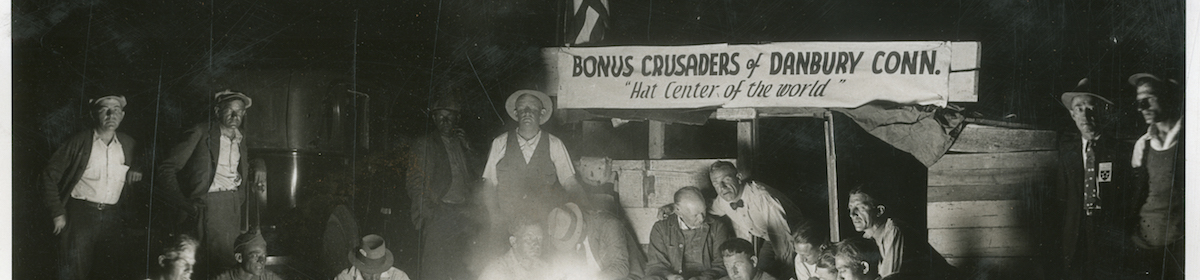
A week later, six men from Danbury arrived to join the thousands of veterans who had already gathered in Washington to push Congress to pre-pay a soldiers’ bonus that had been awarded in 1924.

John R. Perkins, May 14th
On May 14th, 1923, the founding Principal (~president) of WestConn, John Russell Perkins, passed away in Danbury at his 20 Terrace Place home. Perkins had been born in Maine, taught at the Gunn School in Washington, CT and had been Principal of Danbury High School. He passed away 20 years after the founding of WestConn.

In 1919, his wife Mary Whittlessey-Brown died during the Spanish Flu epidemic. Their son, John Jr., was an officer in the U.S. Army and daughter, Margaret, studied law at the University of Chicago. She was an attorney with Kirkham, Cooper, Hungerford and Camp in New Britain around 1924 and married Mortimer Camp of that firm in April of 1928.
In September 2011, John Perkins III met with Archives staff and donated some books to WestConn’s collection.

In May 2012, his great-great-grandson, Brian Ugurlu (in purple shirt), toured campus with his cousin.

White and Main
A new building is going up at the corner of White and Main Streets in Danbury.
For many decades a hotel stood at that spot called the Wooster House

After fires and other troubles, it became the site for Feinson’s.

In 1955, it was flooded.

We look forward to seeing what is built in this important spot.
Earth Day
 WestConn’s archive has a small collection of scientific illustrations among its holding. There are quite a few drawings of snakes.
This particular drawing is a mid-19th century drawing from:Natural History of New York, Zoology of New York – plates

April 9, 1865
Connecticut troops in the 10th Connecticut Infantry and 1st Connecticut Cavalry were among the troops that were present for Confederate General Robert E. Lee’s defeat and surrender at Appomattox, VA on April 9, 1865. Among them was Charles H. Jennings of Co. H, 1st CT Cavalry from Danbury, CT. (Find-a-grave listing)
The Military and Civil History of Connecticut during the War of 1861-65
Dr. Annie Keeler Bailey: women doctors in Danbury, divorce in the 19th Century, and doomsday!
Read about Library Systems Specialist Stacy Haponik’s research on this fascinating Danbury figure.
https://archives.library.wcsu.edu/omeka-s/s/familydrama/page/overview
Ukraine
Ukraine is a country. Here is a presentation by a Ukrainian-American on the history of the country for the Greater Danbury Intercultural Association in the late 1970s-early 1980s.